
What Do We Really Value? The Unseen Cost of Caring for Another Human Being

As a society, we like to believe that we value family, responsibility, compassion, and the dignity of every human life.
But our priorities are not ultimately revealed by what we say. They are revealed by what we are willing to provide, what we are willing to fund, and what we are willing to leave for someone else to carry.
What does it say about us when the person who steps forward to assume responsibility for another human being becomes the person who pays the greatest price for doing so?
What does it say when we recognize that someone requires continuous care, yet accept arrangements that leave a family member responsible for meeting those needs without adequate resources or relief?
We recognize these caregivers. We acknowledge their sacrifices. We praise their devotion.
We call them selfless. We call them heroes.
And then we look away.
But perhaps our admiration does more than allow us to look away. Admiration can become a substitute for accountability. And the praise we offer can shape how caregivers understand their own experience.
There is a kind of moral concealment of exploitation that can occur when we frame extraordinary sacrifice as an expression of love. The love is real, but the language we use to celebrate it can make an unjust distribution of responsibility appear virtuous rather than unreasonable.
And perhaps caregivers themselves struggle to recognize this because the truth is deeply painful. To acknowledge exploitation is to confront the possibility that others have accepted the loss of their well-being as the price of someone else’s care. That recognition can feel like betrayal, especially when seeing the injustice offers no escape from it.
We may have created a way of speaking about caregiving that protects everyone from confronting the truth, although the consequences of that protection are anything but equal.
When Everything Changes
Eight years ago, my eighteen-year-old son, Jonathan, sustained a catastrophic traumatic brain injury that left him with profound disabilities and a need for continuous care.
I am his mother, his legal conservator, and his full-time caregiver.
Jonathan is an adult who requires extensive assistance with daily living, supervision for his safety, and ongoing support to participate in the world around him. His care requires knowledge, physical ability, judgment, patience, and experience.
This is not the ordinary responsibility of raising a child. There is no approaching stage of independence when these responsibilities will naturally diminish. As Jonathan and I grow older, the question of how his care can be sustained becomes more pressing, not less.
Before his injury, I was going about the normal business of raising a family and building a professional career. I have a master’s degree in psychology and teaching credentials in special education. I had an income, health insurance, retirement benefits, and a future I had worked hard to build.
Then everything changed.

In the aftermath of Jonathan’s injury, I was also a single parent, responsible for supporting my other children while navigating his extraordinary care needs. Their needs did not diminish because their brother’s needs had increased.
I stepped into this role because my son needed me. I learned to navigate medical decisions, rehabilitation, disability services, and the daily realities of caring for an adult with profound disabilities.
I do not regret that decision. But I have come to question what our society expects of the people who make it.
We already know that our society falls short in meeting the needs of people with disabilities. Those failures deserve more attention. But there is another part of this picture that receives far less consideration.
What happens to the person who steps forward into the gap between the care someone needs and the care our systems actually provide?
We have made caregivers essential to sustaining the lives of others without adequately considering what is happening to their own.
When Love Becomes the Staffing Plan
In most settings where a person requires continuous, complex care, that responsibility is shared. There are trained staff, scheduled shifts, provisions for illness and time off, and an expectation that no single worker can remain responsible indefinitely.
But when that same level of care is provided at home by a family member, those expectations can disappear.
Jonathan requires assistance and supervision around the clock. That does not mean I am performing hands-on tasks every minute. It means I am responsible for ensuring his needs are met at every hour of the day and night, whether I am being paid or not.
There is no shift change. No one arrives when I am sick, exhausted, or need to attend to my own life. I have no reliable backup when arrangements fall through.
And unlike an ordinary job, I cannot simply leave when my shift is over.
Because there is no shift that truly ends.
Just last night, Jonathan called for me at 1 a.m. I got up to see what he needed and did not return to bed until 3 a.m. By 7 a.m., I needed to be up again to begin his morning care.
I had arranged for a qualified caregiver to come to our home for a few hours so I could have brunch with a friend. At $32 an hour in 2026, even that small opportunity required a significant financial investment and I still needed to complete Jonathan’s more demanding morning care before the helper arrived.
Then the caregiver became sick and canceled at the last minute. I had no backup, so I had to cancel my plans, also at the last minute.
Even when arrangements work, those few hours away require considerable preparation, expense, and energy. And when I return home, I resume responsibility for Jonathan’s care.
This is not simply the inconvenience of having plans disrupted. It is what happens when one person remains the foundation of an entire care arrangement, with no dependable system to relieve them.
But there is something more troubling here.
The better I am at meeting Jonathan’s needs, the easier it is for others to assume that those needs are being adequately met. My competency can conceal the demands being placed upon me.
The fact that I have learned to carry this responsibility does not mean I have the capacity to carry it indefinitely.
The system can depend on my willingness to keep going even when doing so comes at a cost to my own health. It can rely on my sense of responsibility to fill gaps that would require additional staffing in any other setting.
And because I continue to meet my son’s needs, the true cost of providing that care remains largely invisible.
A person’s willingness to endure something does not make it reasonable to expect it of them.
When a system depends on a caregiver’s love and sense of obligation to sustain conditions that would normally be considered unreasonable, we need to ask whether we are witnessing sacrifice or exploitation.
The Costs We Choose Not to Count
As Jonathan’s conservator, I have legal responsibility for ensuring his care and well-being. But accepting responsibility does not magically provide the resources necessary to fulfill it.
Publicly funded home-care programs compensate caregivers for authorized hours of care. For us, as for many families, those hours are substantially fewer than the 24 hours a day, seven days a week during which he requires assistance or supervision.
Being paid for a limited number of hours does not mean the responsibility ends when those hours are over.
If Jonathan lived in a residential facility, responsibility for maintaining continuous care would be distributed among paid staff. At home, it falls on me.
I cannot afford to hire enough qualified help to provide the care he requires while I work elsewhere. And because I cannot work elsewhere, I cannot earn enough to hire that help.
It is a closed circle.
Meanwhile, the professional income and benefits I spent years building have been replaced by caregiving wages that cannot provide the same financial security. The consequences extend beyond me to my other children, our household, and the future I am able to prepare for.
Public discussions about disability services often focus on what those services cost taxpayers. But government budgets tell only part of the story.
When a family caregiver provides unpaid assistance, that care still has economic value. When someone leaves a career, the lost income and retirement benefits are real. When reliable relief is unavailable, the consequences to health and relationships are real.
The cost of care has not disappeared. It has simply been transferred.
Whose Responsibility Is It?
Some will ask why this should be anyone’s responsibility beyond the family. But disability, illness, and dependency are not exclusively family matters. They are human realities that any of us may face.
I recognize how fortunate Jonathan and I are that I am able and willing to provide his care. Without it, his options would likely be far more restrictive, and the life we have built together might not be possible.
But Jonathan is not the only one who benefits from the care I provide. Other family members, healthcare systems, and society itself benefit as well. My willingness and ability to shoulder this responsibility substantially reduce the labor and financial resources that would otherwise be required.
And what of those who don’t have someone able and willing to make these sacrifices? Their needs are no less significant, and their lives are no less valuable. Yet their opportunities for independence, relationships, and meaningful participation in life may be profoundly limited simply because no one is available to provide what they need.
Should the quality of someone’s life depend so heavily on whether another person is willing and able to sacrifice their own? And should that willingness relieve everyone else of responsibility?
Our good fortune should not become the justification for an unjust arrangement.
And perhaps one of the most troubling aspects of this arrangement is how easily the person providing the care disappears from our consideration.
We can talk about valuing caregivers while still writing them out of the story.
We recognize their responsibility to another human being without giving equal consideration to what that responsibility means for their own life.
Caregiving circumstances differ. Some families have more support, greater financial resources, or less intensive care needs. But where essential services are inadequate, the consequences often fall on whoever is willing and able to fill the gaps.
And once that person becomes experienced and dependable, their continued availability can begin to be treated as a given.
We have allowed essential care to become the responsibility of whoever is least willing to let the person in need go without it.
That is not always a freely made sacrifice. Sometimes it is what happens when the alternatives are unacceptable.
The fact that we found a way to continue did not mean the demands were reasonable.
It meant the consequences of stopping were unacceptable.
The Life We Are Trying to Protect
Jonathan is a young man who deserves opportunities to participate in life as fully as possible. His needs extend far beyond assistance with daily physical care.
He needs people with the training, physical ability, judgment, and social and emotional skills to support him safely and meaningfully in the world.
Communication is part of that support. Jonathan speaks, but his voice is quiet and his responses can be delayed. Understanding him takes time, patience, practice, and familiarity. He needs people who will give him time to communicate and help others understand him while respecting his own voice and choices.
The right support doesn’t simply keep him safe. It helps ensure that he can be heard, included, and engaged in his own life.
That kind of support cannot always be provided by just anyone who happens to be available.
And when qualified support is unavailable, it affects both of us. Jonathan’s opportunities become more limited, and so do mine.
There is something genuinely beautiful about the life Jonathan and I have created together. There is also profound loss.
Jonathan lost abilities and opportunities when he sustained his injury. I lost much of the life I had known and the future I had been building. Our losses are different, but both are real.
And in the midst of those losses, we have discovered love, connection, meaning, and possibilities that neither of us could have anticipated.

Why do we assume that because someone has found a way to live fully within real constraints, the circumstances they’re living under cannot be extraordinarily difficult?
I shouldn’t have to stop smiling for my exhaustion to be real.
There is injustice here, too.
Not in Jonathan’s disability or in my love for him, but in the conditions under which we are expected to build and sustain our lives.
Both of our lives have value. Both of our needs matter. And neither of us should have to sacrifice our well-being for the other to have a meaningful life.
What Do We Really Value?
We have become remarkably comfortable relying on sacrifices from family caregivers that we would never consider reasonable to demand openly.
Perhaps that is because the demands are rarely made openly. They emerge through inadequate services, limited resources, and the quiet assumption that someone who loves the person needing care will find a way.
I love my son. I am grateful for the extraordinary life we share, and I do not regret stepping forward to care for him.
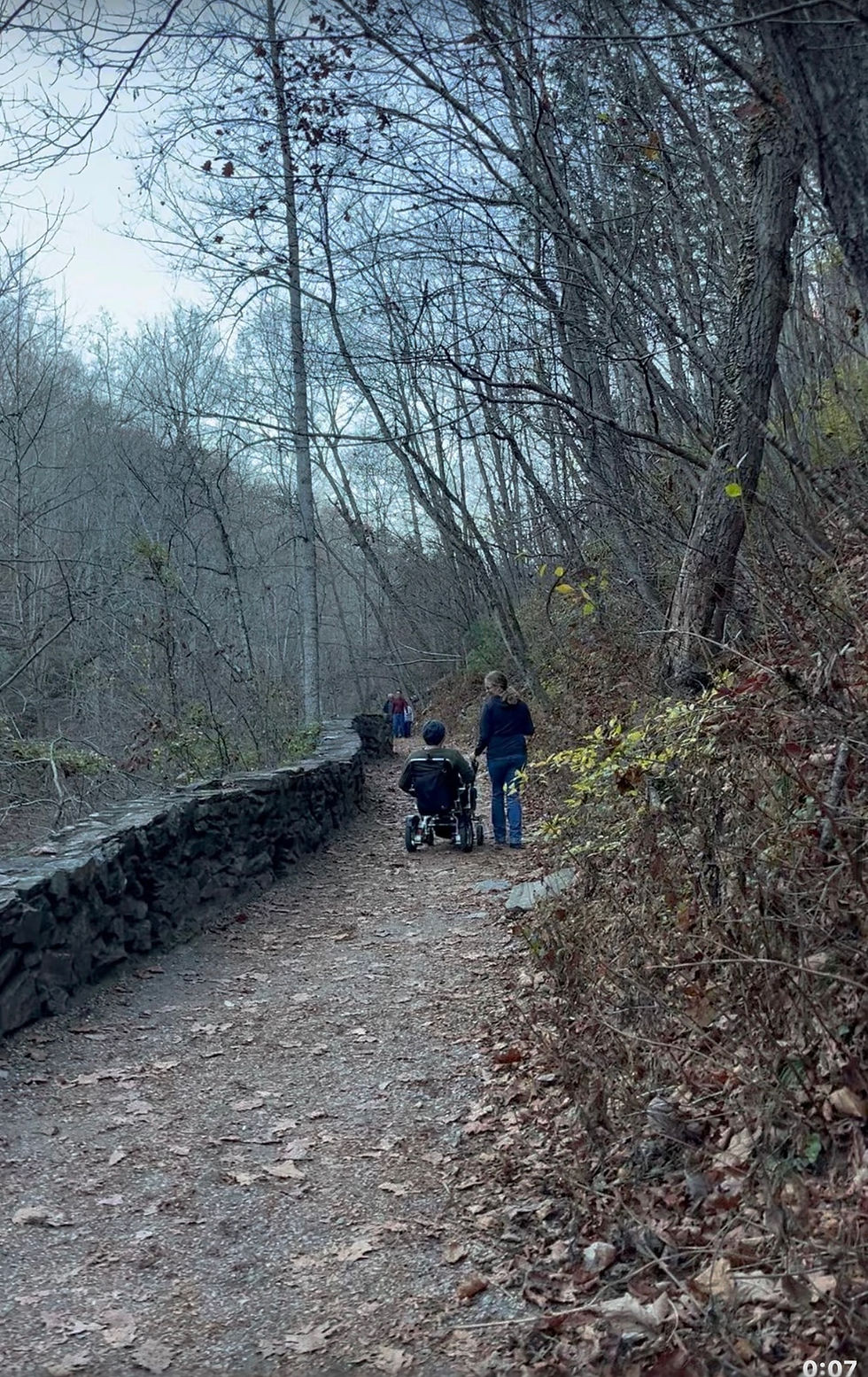
People see Jonathan receiving care. They see our adventures, the possibilities we continue to discover, and the life we have created together.
What they may not see is what it takes to make those things possible.
Our lives together are evidence of what love, determination, and extraordinary effort can accomplish. They are not evidence that the conditions under which I am expected to sustain them are reasonable or sustainable.
If we truly value both the people receiving care and those providing it, shouldn’t the systems we create reflect that?
And what happens when the person everyone assumes will find a way simply can’t anymore?



Comments